
If you have ever stood in front of a mirror, frustrated by a breakout that simply won’t budge despite your best efforts, you are not alone. You’ve likely tried the “viral” store-bought cleansers, the intense scrubs, and perhaps even some DIY kitchen remedies. And yet, the acne remains.
The truth is, acne is not a monolithic condition — it’s a diverse, complex spectrum. Treating a deep, cystic nodule like a simple blackhead isn’t only ineffective, it can often exacerbate your skin health, leading to further inflammation and lasting damage. In this guide, we’ll decode the different types of acne, explain the underlying causes that trigger them, and provide a clear roadmap to professional, lasting results — the kind our dermatologists build for patients in Mumbai, Pune, and Dubai.
The Foundation: What Actually Causes Acne?
To move past the frustration of trial-and-error, we must first understand the biology of your skin. Acne is a disorder of the pilosebaceous unit — the anatomical structure consisting of a hair follicle and its associated sebaceous (oil) gland.
When this system functions normally, it’s invisible. When it malfunctions, we see acne.
The “Big Four” Triggers
- Sebum production (the oil factory). When hormones — specifically androgens — stimulate the oil glands, they can shift into overdrive, creating a breeding ground for bacteria.
- Hyperkeratinization (the cellular traffic jam). Ideally, dead skin cells shed and move to the surface to be washed away. In acne-prone skin, these cells fail to shed properly, creating a “plug” or impaction in the pore.
- Bacterial proliferation. Cutibacterium acnes (C. acnes) naturally exists on our skin. However, when trapped in an oil-clogged, oxygen-deprived pore, it multiplies rapidly.
- Inflammation (the immune response). The body’s immune system recognizes this bacterial overgrowth as a threat and dispatches white blood cells. This immune response creates the redness, swelling, and pus we associate with a breakout.
Understanding that this is a biological process helps remove the stigma: acne is not a result of “bad hygiene.” It’s a medical condition that requires a clinical approach.
Decoding the Spectrum: Different Types of Acne
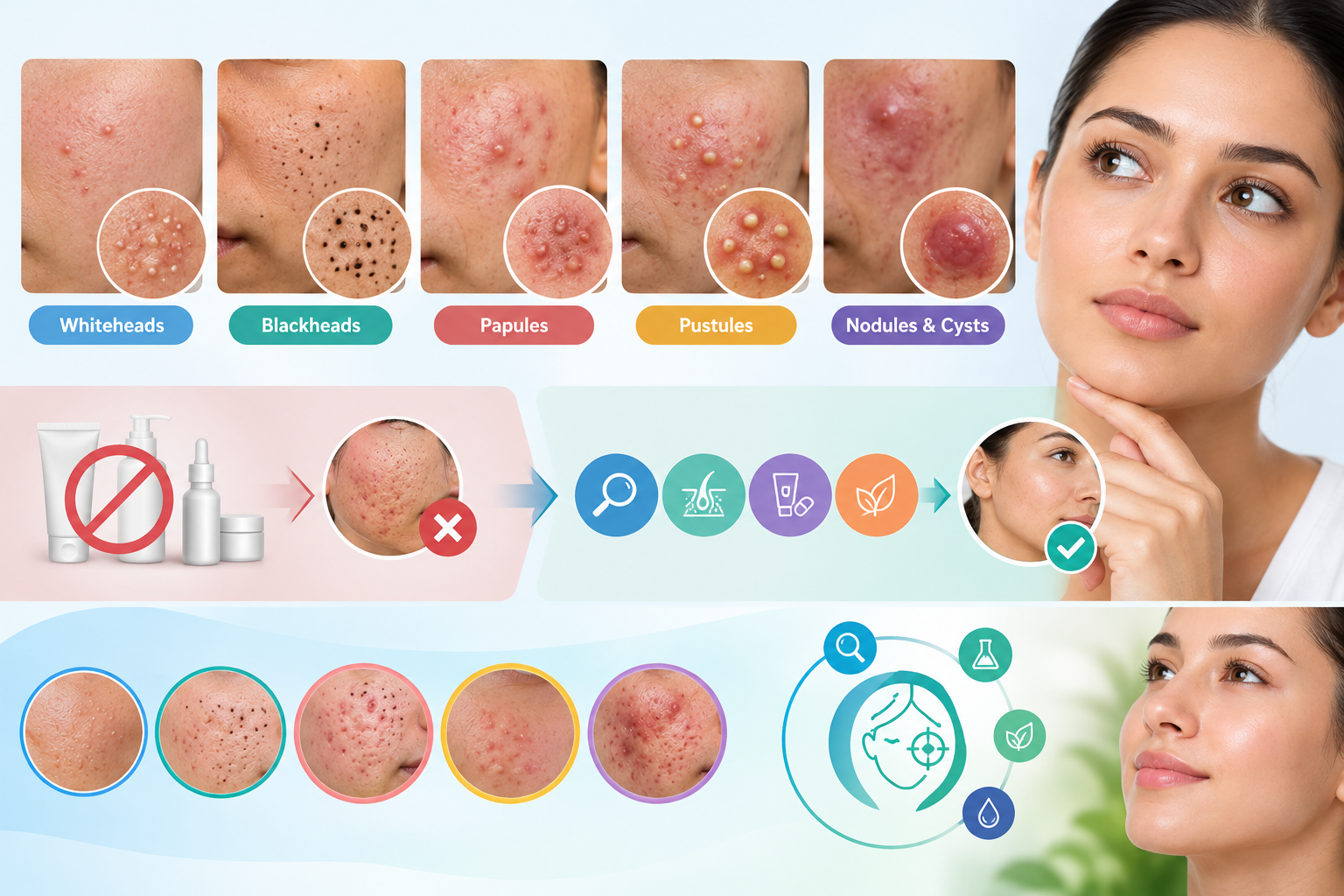
Effective treatment begins with accurate identification. Because each type of acne stems from a slightly different dysfunction, the treatment strategy must be customized accordingly.
1. Non-Inflammatory Acne (The Congestion Phase)
This includes blackheads (open comedones) and whiteheads (closed comedones). These occur when the pore is clogged but there’s minimal active bacterial infection.
The treatment focus: exfoliation and decongestion. We use professional-grade agents like our Salicylic Peel to help the skin shed excess cells and clear the “plugs” before they evolve into something more inflammatory.
2. Inflammatory Acne (The Immune Response)
This category includes papules and pustules — the red, angry bumps that signify an active immune battle.
The treatment focus: agents that calm inflammation and neutralize bacteria, such as our Black Peel or Blue Light Facial phototherapy. Harsh scrubbing here is counterproductive — it destroys the skin barrier and makes the inflammation worse.
3. Severe Acne (The Structural Danger Zone)
This involves nodules and cysts — deep-rooted, painful lesions that occur beneath the dermis. These are the “scar-makers.”
The treatment focus: clinical intervention is non-negotiable. Trying to treat a cyst with over-the-counter drying agents is akin to trying to put out a house fire with a water pistol. These require professional-grade, targeted therapies like our Laser Acne Reduction Facials to reduce the risk of structural damage.
Why misalignment is the enemy: if you treat a nodule with an exfoliant meant for blackheads, you’re wasting time. If you use a heavy moisturizer on congested skin, you’re feeding the bacteria. Precise identification is the prerequisite for improvement.
Not sure which category your acne falls into? Book a one-on-one evaluation with our dermatology team in Mumbai, Pune, or Dubai and get a diagnosis, not a guess.
The Cycle of Recurrence: Why Does Acne Keep Coming Back?
The “revolving door” of acne — clearing up for a week, only to break out again — is one of the most common reasons patients feel hopeless. There are three primary reasons this cycle persists:
- The “stopping too soon” trap. Patients often quit their regimen the moment the surface looks clear. However, the internal inflammation is still present. Stopping too soon allows the cycle of hyperkeratinization and oil production to reset.
- The hormonal/lifestyle pendulum. Hormones, cortisol (stress), and diet are powerful drivers of the sebaceous glands. If these internal triggers aren’t managed alongside your topical care, the acne will naturally recur.
- The need for long-term maintenance. Acne is a chronic condition. Treating it requires shifting from a “crisis management” mindset to a “long-term maintenance” mindset — the goal is remission, not just a temporary surface clear.
The Solution: Moving from Trial-and-Error to Clinical Expertise
If you’re tired of playing the guessing game with your skin, it’s time to pivot to a professional framework. Home remedies rarely penetrate deep enough to address the root of cystic or recurring acne.
At Tender Skin International, we specialize in a “whole skin” approach. We believe in clinical precision over generic solutions. Through our Acne and Acne Scar Treatments, we help you move beyond the trial-and-error phase.
Our clinical advantage includes:
- Diagnostic precision. We identify your specific triggers — whether hormonal, environmental, or related to your specific skin type.
- Layered therapy. We treat active acne and skin texture simultaneously, ensuring that while we’re clearing the current breakout, we’re also protecting the skin’s structural integrity.
Stop waiting for your skin to “outgrow” acne. Let our experts provide the diagnostic and personalized plan your skin requires. Book a consultation at Tender Skin International today → and start your roadmap to clarity.
Addressing the Lingering Fear: Can Acne Scars Be Removed?
A common question we hear is, “Even if the acne stops, what about the marks left behind?”
It’s important to distinguish between Post-Inflammatory Hyperpigmentation (PIH) — the flat, red, or brown marks — and textural scarring, which involves an actual change in the collagen structure of the dermis.
- The reality check. While “erasure” is a clinical myth, “clinical remodeling” is a medical reality. Through technologies like our CO2 Fractional Laser, Authentic Derma Pen microneedling, and scar subcision, we can stimulate the body to produce new, healthy collagen, smoothing the texture and making scars virtually invisible.
- The prevention message. The absolute best way to handle scars is to stop the inflammatory acne now. Every new, deep cyst is a potential new scar — investing in clearing your skin today is the ultimate form of scar prevention.
Why Choose Tender Skin International
Getting the right diagnosis isn’t just about the tools used — it’s about who is reading your skin. Tender Skin International has spent over 20 years treating skin and hair concerns for more than 200,000 patients across our clinics in Mumbai, Pune, and Dubai.
- Experienced doctors. Our team is led by Dr. Sonia Tekchandani, co-founder of TSI, with over 25 years of clinical and teaching experience in medical aesthetics.
- Diagnosis before treatment. Every case starts with a one-on-one evaluation to correctly classify your acne type before any procedure is recommended.
- Clinical-grade technology. From salicylic and Black Peels to laser and microneedling-based scar therapies, treatments are matched to your specific acne category and severity.
- A long-term plan, not a single visit. We monitor your skin’s cycle over time and adjust treatment as it improves, to reduce the chance of recurrence.
Meet Your Acne Specialists
Dr. Sonia Tekchandani — Dermatologist, Co-Founder. Dr. Sonia Tekchandani is a renowned dermatologist and co-founder of Tender Skin International, India & UAE. With over 25 years of clinical and teaching experience, she is an award-winning celebrity dermatologist known for her injector skills and eye for facial aesthetics, trusted by 200,000+ patients.
Dr. Shikha Shah — Dermatologist & Cosmetologist. Dr. Shikha Shah has been with Tender Skin International for over two and a half years, building treatment plans around close listening to each patient’s specific concerns.
Conclusion
Acne is a complex, persistent condition, but it is not a permanent sentence. The frustration you feel when treatments fail is a sign that your skin requires a more sophisticated, customized strategy — not that you’re “doing it wrong.”
Identifying the specific type of acne you face is the first logical step toward reclaiming your skin. Clarity is not just a dream; it’s a clinical process. By breaking the cycle of recurring inflammation and partnering with experts who understand the biology of your skin, you can finally achieve the health and confidence you deserve.
Frequently Asked Questions
Can I have more than one type of acne at once?
Absolutely. It’s very common to experience “mixed” acne, such as blackheads on the nose and cystic nodules along the jawline. This is why a customized, layered treatment plan is so essential — you may need different treatments for different areas of your face.
Why does my acne get worse when I use a new product?
This is often called “purging.” If you begin a new, effective treatment that increases cell turnover (like a professional-grade exfoliant or retinoid), it can bring underlying congestion to the surface faster than usual. This is usually temporary and a sign that the treatment is working.
Are home remedies effective for cystic acne?
Generally, no. Cystic acne is deep beneath the surface of the skin. Most home remedies or drugstore creams can’t penetrate to the level where the inflammation is occurring. Attempting to “treat” a cyst with harsh at-home scrubs often leads to broken skin and increased scarring.
Is acne a lifelong condition?
Acne is a chronic, relapsing condition, but that doesn’t mean you’ll struggle with it forever. With the right clinical management and long-term maintenance, most patients achieve long periods of remission and eventually reach a state where their skin is managed with minimal effort.
For questions about treatment safety, side effects, or how long results last, see the FAQ on our Acne and Acne Scar Treatments page.